Textile and apparel sourcing from China fails at the fabric stage far more often than at the sewing stage. Three checks decide whether a shipment arrives sellable: whether the whole order came from one dye lot, whether the fabric weight and fibre content match the specification, and whether any certification claim can be verified against the issuing body’s public database.
In this guide
- Why the fabric stage decides everything
- Dye lot control: the largest single source of claims
- What to measure: weight, composition and shrinkage
- Verifying certifications: OEKO-TEX, GOTS and GRS
- The inspection standard: ISO 2859-1 at AQL 2.5 and 4.0
- Labelling: the compliance risk that ships with the goods
- Textile and apparel sourcing from China: 6 checks
- Where textile and apparel sourcing from China goes wrong
- Key takeaways
- Where SourceEyes helps: the China half
- Frequently asked questions
Why the fabric stage decides everything
Sewing defects are visible and correctable. Fabric defects are neither. A colour that drifts between dye lots shows up only when the cartons are opened side by side, and a fabric weight that is 8% light cannot be fixed on the cutting table at all.
That asymmetry is why textile and apparel sourcing from China rewards buyers who spend their attention early. In knitwear and woven apparel, the decisions that get locked in before production are the fibre, the yarn count, the fabric weight, the dye lot, and the shade standard. Everything after that is execution against a spec that is either right or wrong.
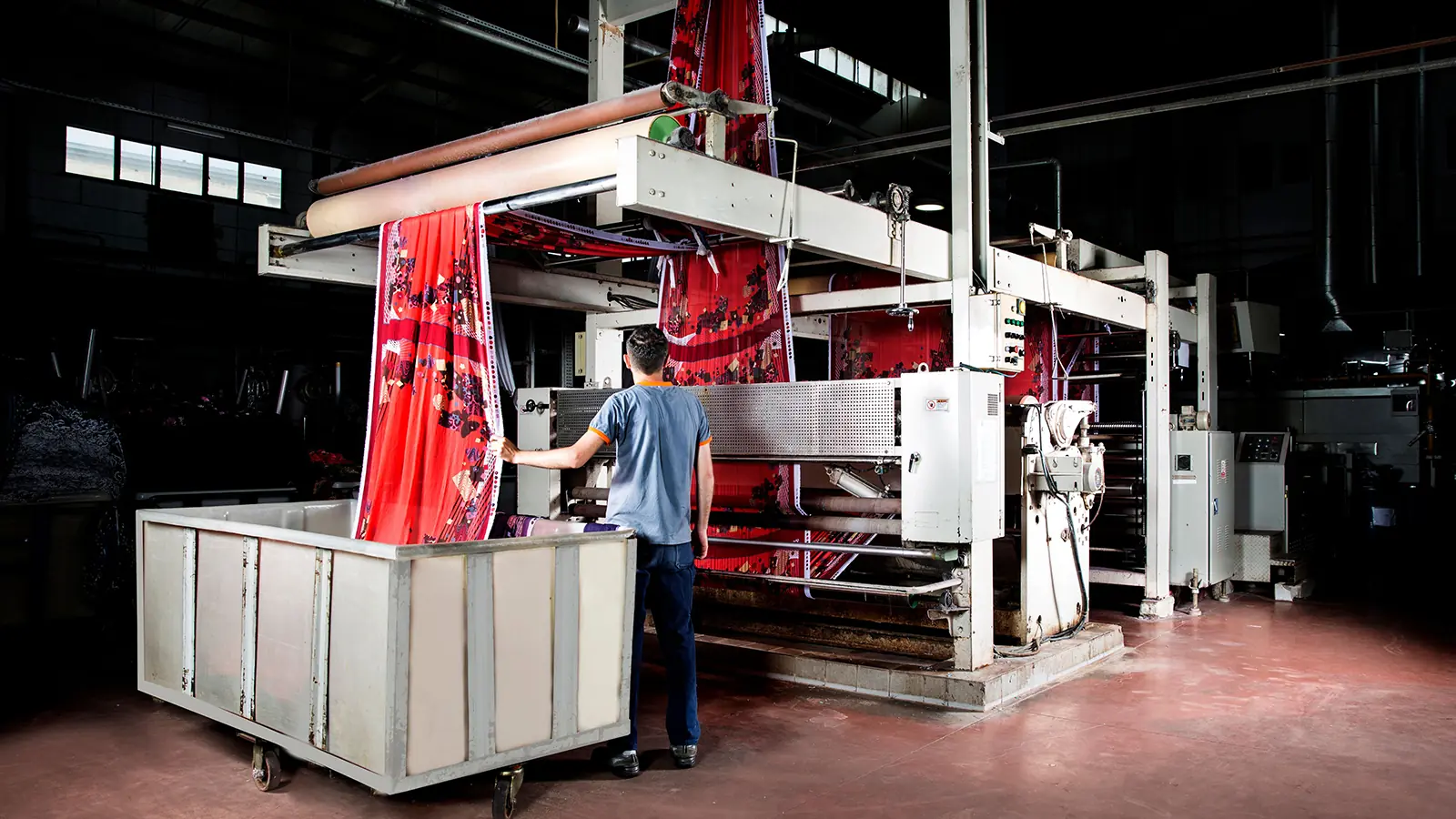
There is also a structural reason the risk concentrates at the mill. A garment factory usually does not dye its own fabric; it buys greige or finished fabric from a mill and cuts it. So a brand ordering through a garment supplier is often three steps from the process that decides its colour consistency. Textile and apparel sourcing from China that never identifies the mill is sourcing a promise rather than a supply chain.
Dye lot control: the largest single source of claims
Shade variation between pieces is the most common claim in textile and apparel sourcing from China, and it almost always traces to one cause: more than one dye lot was used, and nobody noticed until packing.
The control in textile and apparel sourcing from China is a single instruction written into the purchase order, not a conversation at the end: all pieces in the order must come from the same dye lot. Where an order is too large for one lot, the buyer should specify the maximum variation between lots in measurable terms rather than asking for “consistent colour”. A commonly used tolerance is a Delta E of 1.5 or less between pieces, supported by dye lot documentation issued with the pre-shipment inspection report.
SourceEyes pins colour to a single dye lot before bulk starts and holds the shade standard as a physical swatch, so the Delta E 1.5 tolerance is measured against something real rather than against a photograph or a memory.
In textile and apparel sourcing from China, colour also has to be judged under a defined light source. Two standard illuminants do the work — D65, which approximates daylight, and TL84, which approximates retail store lighting. Fabric can pass under one and fail under the other, and that is exactly how a colour accepted in a Shenzhen inspection room becomes a return in a European store.
Two habits make the difference in textile and apparel sourcing from China. First, approve a lab dip before bulk dyeing and keep it as the physical standard, not a photograph — a phone image of a swatch is not a colour standard. Second, for orders that run across several weeks, ask for the dye lot number on every carton so a mixed-lot shipment is caught at loading rather than at the customer.
What to measure: weight, composition and shrinkage
Three measurements carry most of the commercial risk in textile and apparel sourcing from China, and all three are cheap to verify:
Fabric weight (GSM). In textile and apparel sourcing from China, grams per square metre is the specification most often quietly missed. A tolerance of ±5% is the working industry standard, verified with a circular cutter and a precision scale rather than by feel. Below the tolerance, the fabric feels thinner, drapes differently and can fail a buyer’s own lab test.
Fibre composition. In textile and apparel sourcing from China, what is declared on the label is a legal statement in most markets, so composition should be verified rather than accepted. Quantitative analysis follows the ISO 1833 series, which uses chemical dissolution to determine the percentage of each fibre present. The gap between a claimed 100% cotton and a blend is not a rounding error; it is a mislabelling exposure.
Shrinkage and dimensional stability. For textile and apparel sourcing from China, a garment that measures correctly at inspection and shrinks 6% after the first domestic wash is a returned garment. Residual shrinkage is measured under AATCC TM135, and a residual figure of 3% or less is the common acceptance benchmark for cotton knitwear. The allowance has to be built into the specification, because shrinkage control is a finishing decision made at the mill.
Add two tests to textile and apparel sourcing from China where the product category warrants them: colourfastness under the ISO 105 series, and pilling resistance under ISO 12945-2, which matters most in knitwear and wool programmes.
Verifying certifications: OEKO-TEX, GOTS and GRS
Certification is the area of textile and apparel sourcing from China where a copy of a PDF proves nothing. Every major standard maintains a public database, and a claim that cannot be looked up in one is not substantiated.
OEKO-TEX Standard 100 tests the finished article against a catalogue of more than 1,000 regulated and unregulated substances — formaldehyde, azo dyes that release restricted amines, heavy metals, phthalates, allergenic disperse dyes and PFAS among them. It carries four product classes: Class I for articles for babies and toddlers up to 36 months under the strictest limits, Class II for items in direct skin contact, and Classes III and IV for articles without direct skin contact and for decoration.
Two facts are widely misunderstood in textile and apparel sourcing from China: Standard 100 does not require organic fibre, and it certifies the article, not the factory. A certificate number is checked on the issuing association’s own site at OEKO-TEX; a certificate is valid for one year.
GOTS certifies a supply chain rather than an article. It requires a minimum of 70% certified organic fibre, applies chemical restrictions at every processing stage rather than only in the finished good, and covers environmental and social criteria with annual audits. Licence numbers are searchable in the GOTS public database, which returns the certified scope, the certifying body and the expiry date.
Recycled content claims are verified through the Global Recycled Standard administered by Textile Exchange, where the database also states the percentage of recycled material covered.
Four failure patterns account for most bad certificates in textile and apparel sourcing from China — SourceEyes meets them on the factory floor in Suzhou:
- A PDF with no visible number. Without a number there is nothing to check.
- An expired certificate presented as current. Renewal is annual, so a document from two years ago may be void.
- A scope mismatch. A factory certified for knit fabric producing your woven order holds a certificate that does not cover your goods.
- A sister-company certificate. A different production unit at the same parent group is certified; the unit making your order is not.
Where a supplier cannot produce a number that resolves in the public database, the practical answer is to stop treating the certification as a selling point and treat it as unpurchased.
The inspection standard: ISO 2859-1 at AQL 2.5 and 4.0
In textile and apparel sourcing from China, goods are inspected by sampling rather than by full count, and the accepted method is ISO 2859-1 (identical in content to ANSI/ASQ Z1.4) at General Inspection Level II. Three defect classes carry different limits:
| Class | AQL | Examples |
|---|---|---|
| Critical | 0 — zero tolerance | Broken needle in a garment, mould, failed flammability label |
| Major | 2.5 | Open seam, visible stain, hole, wrong size label, shade variation |
| Minor | 4.0 | Untrimmed thread, slightly skewed label, light crease |
Sample size depends only on lot size, and the numbers are worth knowing before an argument starts:
| Lot size (pcs) | Sample size | Major 2.5 accept/reject | Minor 4.0 accept/reject |
|---|---|---|---|
| 501 – 1,200 | 80 | 5 / 6 | 7 / 8 |
| 1,201 – 3,200 | 125 | 7 / 8 | 10 / 11 |
| 3,201 – 10,000 | 200 | 10 / 11 | 14 / 15 |
So for a 5,000-piece order in textile and apparel sourcing from China the inspector pulls 200 pieces. If 10 or fewer major defects are found the lot passes on majors; at 11 or more it fails. Critical defects are never accepted at any lot size. Premium programmes sometimes tighten majors to AQL 1.5, and the sampling table is the standard published by ISO.
One practical warning about textile and apparel sourcing from China inspections: defects hide from flat viewing. In a documented knitwear case, 125 sweaters sampled from a 3,500-piece order showed a subtle horizontal stripe visible only under side lighting — classified as major because of its position across the chest. Root cause analysis traced it to a faulty positive-feed unit on one of eight knitting machines, and 340 affected pieces were quarantined by machine number rather than scrapping the order. That outcome requires traceability from yarn lot to machine, which is a question to ask at the audit stage.
Labelling: the compliance risk that ships with the goods
In textile and apparel sourcing from China, fabric and workmanship problems are commercial. Labelling problems are regulatory, and they travel with the goods into the destination market.
In the European Union, textile fibre names and composition labelling are governed by Regulation (EU) No 1007/2011, which sets the permitted fibre names and the requirement to state composition accurately. In the United States the equivalent framework is the Textile Fiber Products Identification Act (TFPIA), which requires the fibre content, the country of origin and the identity of the manufacturer or marketer. Care labelling and country-of-origin marking follow their own rules on top of that.
For textile and apparel sourcing from China the exposure sits in a specific place: labels are printed and attached by the factory, often from artwork the buyer supplied and never re-read. A wrong fibre percentage or a missing origin mark is discovered by a market surveillance authority, not by a customer, which makes it the most expensive class of defect in the category. Reviewing label artwork against the test report before production is the whole control.
Textile and apparel sourcing from China: 6 checks
- Identify the mill behind the garment factory. Ask which mill dyes the fabric and whether the same mill runs bulk. Textile and apparel sourcing from China that skips this step cannot control colour, because the process that decides it has not been located.
- Approve a physical lab dip and fix the shade standard. A physical swatch, not a photograph, and a written tolerance — Delta E 1.5 or less between pieces — agreed before bulk dyeing starts.
- Specify one dye lot in the purchase order. Where volume makes that impossible, require dye lot documentation with the inspection report and dye lot numbers on cartons.
- Write weight, composition and shrinkage into the spec as testable numbers. GSM within ±5%, composition verified by ISO 1833 analysis, residual shrinkage under AATCC TM135 at 3% or less.
- In textile and apparel sourcing from China, resolve every certificate number in the public database. OEKO-TEX and GOTS numbers are searchable for free, and the check that matters is the scope — whether the certified product range and the certified production unit are the ones making your order.
- Agree the AQL level and the label artwork before production. AQL 2.5 major / 4.0 minor is the default; the label has to be checked against the fibre test report, not against the buyer’s memory.
Where textile and apparel sourcing from China goes wrong
Five failures recur in textile and apparel sourcing from China, and none of them is a surprise once it happens:
Mixed dye lots shipped as one order. Caught only when cartons are compared side by side, which is usually after delivery. Same-lot specification and carton-level lot numbers are the fix.
Fabric weight at the bottom of tolerance, or below it. A ±5% tolerance sounds generous until a supplier treats the minus side as the target and the garment fails a buyer’s independent lab test.
A certification covering the wrong scope. In textile and apparel sourcing from China the most common variant is a certificate the parent group holds while a different unit produces the order. Verification takes minutes and is skipped because a PDF was received.
A lab dip approved from a phone photograph. Screen colour is not fabric colour, and the disagreement surfaces at the inspection table with no agreed standard to settle it.
Labels never compared to the test report. Composition printed from an early artwork draft and shipped after a fibre change during sampling. This is the one that reaches a regulator.
Key takeaways
- Colour is a mill decision. In textile and apparel sourcing from China, identify who dyes the fabric, then fix one dye lot and one physical shade standard in writing.
- Three numbers carry the risk. GSM within ±5%, composition by ISO 1833, residual shrinkage ≤3% under AATCC TM135.
- Certificates are looked up, not filed. OEKO-TEX and GOTS numbers resolve in public databases, and the scope matters as much as the validity date.
- Inspect to ISO 2859-1 Level II. AQL 2.5 major, 4.0 minor, zero critical — 200 pieces from a 5,000-piece lot, failing at 11 majors.
- Labelling is the regulatory exposure. EU 1007/2011 and the US TFPIA are checked against the fibre test report before print, not after arrival.
Where SourceEyes helps: the China half
SourceEyes is a sourcing and QC team based in Suzhou, China, working the China side of textile and apparel sourcing from China, from finding the right factory to loading your goods on board — which is where the SourceEyes scope ends. Destination-market labelling rules and import clearance sit on your side, and SourceEyes hands over the documents your importer needs.
For a textile programme the sequence SourceEyes runs is mill first, standard second, production third. On the ground that means identifying the mill behind the garment factory before a deposit is placed, verifying a claimed OEKO-TEX or GOTS number against the public database and checking that the certified scope covers your fabric, and approving the shade standard as a physical swatch that stays with SourceEyes as the reference.
Before loading SourceEyes inspects against the approved sample: colour under D65 and TL84, GSM by circular cutter and scale, garment measurements relaxed across every size, carton and label data. Photographs and a written report come with it. Leown Zhang runs inspections, Quinn Sun handles supplier research and logistics coordination, and Betty Gao takes the commercial side.
See what that covers on the SourceEyes services page or check indicative fees on pricing. The pre-shipment inspection checklist shows what an inspection should include, how to get product samples from China covers the sample round that sets your shade standard, and how to choose a factory in China covers the audit before it. Landed-cost arithmetic for a first order is on the import cost calculator.
Tell us the product and the quantity, and SourceEyes will tell you what textile and apparel sourcing from China looks like from the China side — including which certifications your factory actually holds and which it only claims. Contact us and a real person replies within 24 hours.
Frequently asked questions
How do I check if an OEKO-TEX certificate is real?
Take the certificate number and look it up on the OEKO-TEX website. The result shows the validity dates, the product class and the articles covered. Check that the certified scope matches what you are ordering, and remember that certificates are valid for one year — a document from an earlier period may no longer be in force.
What AQL should I use for garments from China?
AQL 2.5 for major defects and 4.0 for minor defects, at General Inspection Level II of ISO 2859-1, with zero tolerance for critical defects. For a 5,000-piece lot that means 200 pieces inspected and a fail at 11 major defects.
Can one order have more than one dye lot?
It can, but the shade will vary between pieces. Specify all pieces from a single dye lot in the purchase order. Where volume makes that impossible, set a measurable tolerance such as Delta E 1.5 or less between pieces and require dye lot documentation with the inspection report.
Does a GOTS certificate mean the factory is certified for my product?
Not necessarily. GOTS certification covers a defined scope — specific products and specific production units. Use the GOTS public database to confirm the scope and the expiry date, and check whether the unit producing your order is the one named on the certificate.
What fabric weight tolerance is normal in textile and apparel sourcing from China?
Plus or minus 5% of the specified grams per square metre is the working industry standard, verified with a circular cutter and a precision scale. Suppliers who treat the minus side of that tolerance as the target are a recurring source of failed lab tests at destination.